
Tallahatchie County Court Records After Arrest
After a Tallahatchie County arrest, custody records and court records split into two tracks. The jail or sheriff records the booking, the legal paper that permits confinement, and the release or transfer result. The prosecutor and court track the charge that is filed in court. Mississippi Electronic Courts, often called MEC, is the official state court entry point for electronic trial-court access, and the Seventeenth Circuit MEC information page lists Tallahatchie County Circuit Court First Judicial District at 1 Court Square in Charleston.
The Seventeenth Circuit Court District covers Panola, Tallahatchie, Tate, and Yalobusha Counties for felony prosecution context. The Mississippi Attorney General district map identifies Jay Hale as District Attorney for District 17, with phone 662-563-6636. Circuit Clerk Daphane Neal is the county official named in the research sources for circuit-court records. For current custody detail, a reader may still need the sheriff's office at 662-647-3700 or Tallahatchie County Correctional Facility at 662-345-6567, but the court record controls the filed criminal case. For the booking side, use Tallahatchie County jail inmate records. For booking photos, use Tallahatchie County jail mugshots.
Custody route: Arrest, booking, first appearance, prosecutor review, filed charge, court docket, then dismissal, plea, trial, sentence, or expunction if ordered.
Search Tallahatchie Court Records
Mississippi Electronic Courts is the main official online path for Tallahatchie County court records after an arrest. The statewide Mississippi Electronic Courts page links to trial-court access and login paths. The Seventeenth Circuit MEC information page gives the Tallahatchie Circuit Court contact listing and confirms the circuit court's MEC status. Online access may require an account or login, so the Circuit Clerk remains the practical fallback for older records, hard-copy files, or public-terminal access.
The Mississippi Electronic Courts page is the official source for Mississippi trial-court access.
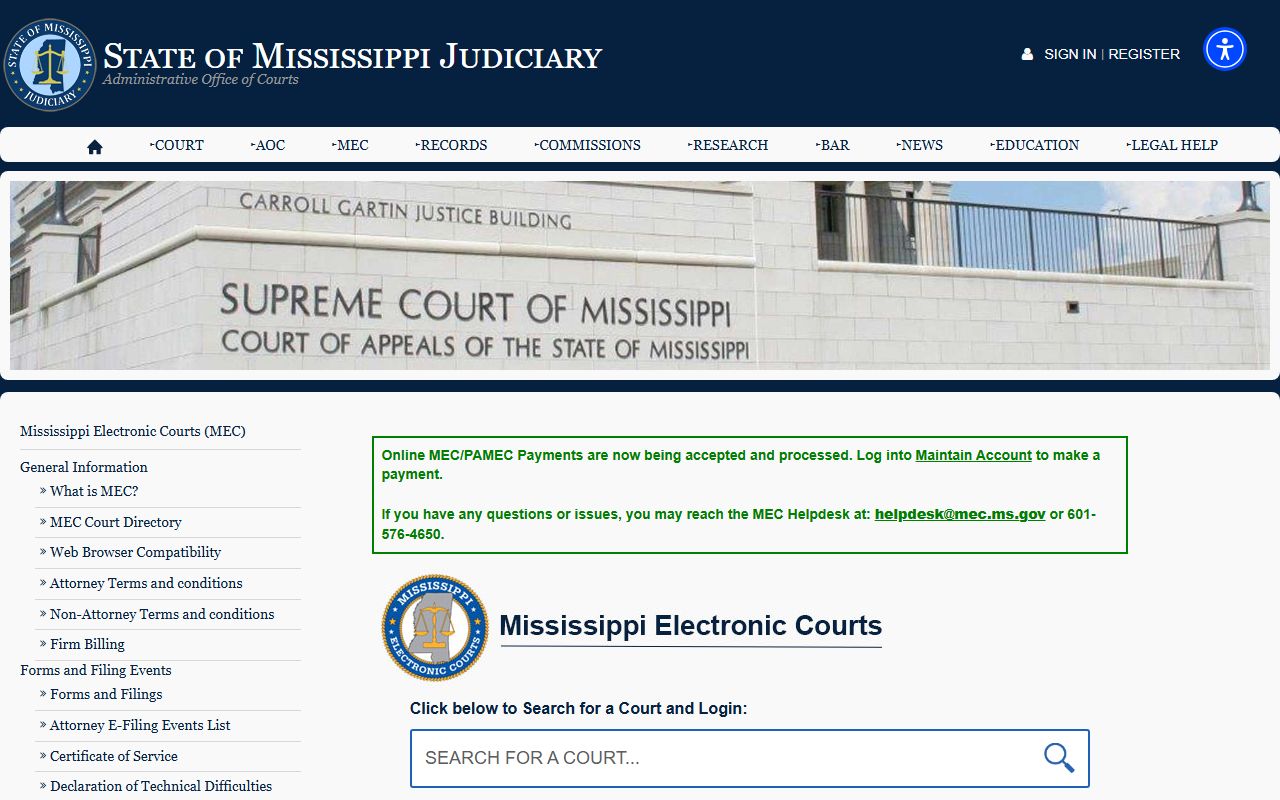
MEC is useful for filed court activity, but it is not a replacement for calling the jail when the question is whether someone is still in custody.
- Confirm the arrest, name spelling, date of birth, and arresting agency through the sheriff, facility, or court paperwork.
- Open MEC and select the Tallahatchie County Circuit Court or other correct court path when available.
- Search by case number when a citation, indictment number, or clerk reference is known. Use party name when no number is available.
- Review the charge list, docket events, bond entries, and case status. Compare each filed charge to the booking label.
- Contact Circuit Clerk Daphane Neal's office if the case does not appear online, if a login is required, or if the matter is in a lower court.
| Field Label | Type | Required | Options / Format Notes |
|---|---|---|---|
| Court selection | Link or dropdown path | Yes | Choose Tallahatchie County Circuit Court or another proper court from MEC. |
| Login/account | Account access | Often required | Public terminals or the clerk are the fallback when online access is limited. |
| Case number | Text | If known | Best for exact searches from citations, indictments, or clerk papers. |
| Party or defendant name | Text | Optional | Use full legal name and known spelling variants. |
| Date range | Date fields | Optional | Use when the portal exposes date filters for filed events. |
Charges Filed After Arrest
Booking happens first. A court charge comes later when a prosecutor or court process turns the arrest report, warrant, citation, or investigation into a filed criminal case. In Tallahatchie County felony matters, the District Attorney's role is to review the arrest, reports, and evidence, then file or present charges as Mississippi procedure allows. Misdemeanors and lower-court matters may involve justice, county, or municipal prosecution depending on the charge and the court.
For Tallahatchie County court records after a jail arrest, the charging paper matters because it shows what accusation is actually before the court. A jail booking label may say one thing at intake. The filed complaint, information, or indictment may be narrower, broader, reduced, or dismissed after review. That is why a court case search should be read with care.
| Document | Who Uses It | What It Does | Record Caution |
|---|---|---|---|
| Complaint | Officer or prosecutor | Starts a criminal accusation in court or lower-court practice. | May be early and may change after review. |
| Information | Prosecutor | Files a formal charge without relying on the same wording used at booking. | Read later docket entries for amendments or plea changes. |
| Indictment | Grand jury | Charges a felony after grand-jury action. | Often becomes the controlling charge document in circuit court. |
Note: A filed charge is an accusation unless and until a plea, verdict, or judgment creates a conviction.
Tallahatchie Charge Status Records
Charge status is one of the most important parts of court records after a Tallahatchie County arrest. A pending charge means the court has not reached a final result. An amended or reduced charge means the original label changed. A dismissal or nolle prosequi means the case or charge did not proceed in its prior form. A conviction means guilt was entered by plea or found by the court or jury.
| Status | What It Means | What to Check Next |
|---|---|---|
| Pending | The charge is unresolved and remains before the court. | Next hearing, bond status, and whether any hold blocks release. |
| Amended | The prosecutor or court changed the filed charge wording or count. | The new charge text, code section, and date of amendment. |
| Reduced | A lesser offense replaced the original charge. | Plea terms, sentencing entry, or dismissal of other counts. |
| Dismissed | The court dropped the charge by order or final action. | Whether expunction may be available under Mississippi law. |
| Nolle prosequi | The prosecutor declined to proceed with that charge. | Whether other counts or related cases remain active. |
| Convicted | Guilt was entered or found. | Sentence, custody agency, probation terms, and appeal status. |
Bond After Tallahatchie Arrest
No official Tallahatchie County bond web page or posted local fee schedule was located in the research. Bond is usually set by a judge or judicial officer after arrest, sometimes at a first appearance or through an amount listed on a warrant. Before anyone posts money, confirm the person's identity, charge, bond amount, court, and hold status with the originating office. Use an official counter or a licensed bond agent and keep the receipt.
Holds are common points of confusion because Tallahatchie County Correctional Facility serves several custody channels. A person may have a local bond yet remain held for ICE, U.S. Marshals Service, probation or parole, another county, or another state. The CoreCivic facility page names Tallahatchie County, Hinds County, U.S. Marshals Service, ICE, and other correctional customers. That makes custody authority just as important as the court docket.
| Bond Type | How It Works | Tallahatchie County Note |
|---|---|---|
| Cash bond | The full cash amount is posted to secure release. | Confirm where payment is accepted before travel. |
| Surety bond | A licensed bail agent posts bond for a fee. | Confirm the person is eligible and not blocked by a hold. |
| Property bond | Property may be used as security when a court allows it. | Court approval is required. |
| Personal recognizance | Release is based on a promise to appear and stated conditions. | Must be ordered by the court. |
| No-bond hold | Release is blocked by court order or another agency. | ICE, USMS, probation, parole, or another county hold may prevent release. |
Warrants Before Court Records
No official Tallahatchie County active warrant search page, sheriff warrant list, or most-wanted page was located. A warrant question should be handled through the sheriff, the Circuit Clerk for circuit filings, the proper justice or municipal court for lower-court matters, and legal counsel when surrender or bond may be needed. The sheriff's directory listing names Sheriff Jimmy Fly, mailing address P.O. Box 100, Charleston, MS 38921, and phone 662-647-3700.
- Arrest warrant
- A court order allowing arrest on a criminal accusation.
- Bench warrant
- A warrant often issued after a missed court date or court-order violation.
- Fugitive hold
- A custody block because another jurisdiction seeks the person.
- Detainer
- A request or hold from another agency that may prevent release after local bond.
Charges and Convictions Compared
Public court records after an arrest can show accusations, not just final findings. A person may be arrested and charged without being convicted. That distinction matters for employers, housing providers, licensing boards, and family members trying to understand a docket. A charge is not proof of guilt. A conviction requires a plea, verdict, or judgment entered in court.
| Point | Charge | Conviction |
|---|---|---|
| Stage | Accusation after arrest or review. | Final guilt finding or guilty plea. |
| Proof level | Based on probable cause or filing decision. | Requires proof beyond a reasonable doubt or a valid plea. |
| Record meaning | May be pending, amended, reduced, or dismissed. | May lead to sentence, probation, prison, or appeal. |
| Custody effect | May affect bond and holds. | May move custody from county jail to MDOC or another agency. |
Expunged Tallahatchie Arrest Records
Mississippi law allows expunction for several dismissed, dropped, no-disposition, not-guilty, and eligible conviction records. The key statute in the research is Mississippi Code section 99-19-71. Expunction is a court process. It is not the same as a website edit, a phone request, or a promise that every third-party copy will vanish.
| Point | Sealed | Expunged |
|---|---|---|
| Public access | Hidden from ordinary public view when a court limits access. | Removed from public access as ordered by the court. |
| How it happens | Usually by statute, court rule, or court order. | By petition and court order under eligible Mississippi law. |
| Local task | Ask the clerk what order controls access. | Provide the order to the clerk or record custodian when asking for correction. |
| Limit | Some government or law-enforcement access may remain. | It may not control copies held by outside publishers. |
Public Access and Limits
The Mississippi Public Records Act is the broad public-records source for records kept by public bodies for public business. The same research notes that Mississippi law does not exempt law-enforcement incident reports from disclosure, while victim-identifying information and other protected details may be withheld. Mississippi Code section 19-25-63 also requires a public jail docket with arrest, commitment, cause, authority, time held, and release details.
Important: Do not use casual court, jail, or custody lookups for credit, employment, tenant screening, insurance, or any other FCRA-covered decision.
Juvenile records, sealed matters, victim details, ongoing investigation material, and expunged records can be restricted. When a case is missing from MEC, that does not prove no arrest happened, no charge was filed, or no case exists. It may mean the court is lower-level, the file is older, access requires login, or the record is restricted. Use the clerk and originating agency to verify.